Note
Go to the end to download the full example code.
Jamming of bidisperse spheres (or disks).#
Find an energy threshold for two tiny bidisperse disk packings in a periodic box. The harmonic contact energy is zero without overlaps and increases quadratically with overlap. Length, mass, and stiffness are in reduced units.
For radii \(R_i\) and pair separations \(r_{ij}\), write
The spring force has magnitude \(k_{ij}\delta_{ij}\). Below jamming,
relaxation can remove every overlap; a compressed force-balanced network can
retain positive energy. We use this change to bracket a numerical energy
threshold. Each trial rescales the box, relaxes forces, and measures energy
per constituent sphere. Equilibrated states below pe_tol form a lower
bound; states above it form an upper bound. Bisection narrows these bounds and
accepts an upper state inside the specified energy band. Mechanical stability
still requires contact and spectral analysis; energy alone does not prove it.
Eight particles, two fixed seeds, moderate tolerances, and bounded iteration counts keep the script quick. Such small packings have large finite-size effects: their jamming fractions are not estimates of the bulk value.
bisection_jam() implements the bisection search.
Imports#
import jax
import jax.numpy as jnp

import jaxdem as jdem

# Double precision keeps the small energy threshold resolved.
jax.config.update("jax_enable_x64", True)
Parameters#
Half the disks have radius 0.5 and half 0.7. The 1.4 size ratio reduces
the tendency toward a simple monodisperse crystal. Independent seeds give
different initial positions at the same nominal packing fraction, allowing
us to inspect finite-sample variation instead of treating one packing as a
universal threshold. vmap adds the system axis; each member retains its
own state, box, and minimization history. Batched relaxation proceeds until
the slowest active member has finished.
N_systems = 2
N = 8
phi = 0.65
dim = 2
e_int = 1.0
dt = 5e-2
For the one-call equivalent see
build_sphere_system()
(sphere_construction example).
def build_microstate(i):
    # assign bidisperse radii
    rad = jnp.ones(N)
    rad = rad.at[: N // 2].set(0.5)
    rad = rad.at[N // 2 :].set(0.7)

    # The d-dimensional particle volumes are V_i = c_d R_i**d, with
    # c_d = pi**(d/2) / Gamma(d/2+1). Set L = (sum(V_i)/phi)**(1/d),
    # so the periodic hypercube has exactly the requested nominal fraction.
    # This yields disk area in 2D and sphere volume in 3D; it counts nominal
    # particle volumes even when the initial random particles overlap.
    volume = (jnp.pi ** (dim / 2) / jax.scipy.special.gamma(dim / 2 + 1)) * rad**dim
    L = (jnp.sum(volume) / phi) ** (1 / dim)
    box_size = jnp.ones(dim) * L

    # create microstate
    key = jax.random.PRNGKey(i)
    pos = jax.random.uniform(key, (N, dim), minval=0.0, maxval=L)
    mass = jnp.ones(N)
    mats = [jdem.Material.create("elastic", young=e_int, poisson=0.5, density=1.0)]
    matcher = jdem.MaterialMatchmaker.create("harmonic")
    mat_table = jdem.MaterialTable.from_materials(mats, matcher=matcher)

    # create system and state
    state = jdem.State.create(pos=pos, rad=rad, mass=mass, volume=volume)
    system = jdem.System.create(
        state_shape=state.shape,
        dt=dt,
        minimizer=jdem.minimizers.fire,
        minimizer_kw={"dt": dt},
        domain_type="periodic",
        force_model_type="spring",
        collider_type="naive",
        mat_table=mat_table,
        domain_kw={
            "box_size": box_size,
        },
    )
    return state, system
A bounded search#
The energy threshold classifies equilibrated states; force_tol controls
the separate inner relaxation. First the search establishes a lower bound
\(\phi_-\) with \(e_-\leq e_{\rm tol}\). It increases packing
fraction until an upper bound \(\phi_+\) has \(e_+>e_{\rm tol}\).
Subsequent trials use \((\phi_-+\phi_+)/2\) and update the appropriate
bound only after force/torque relaxation has converged.
A successful upper state satisfies both
where b = pe_band_factor and epsilon_phi is the relative bracket
tolerance. Thus the returned upper energy is deliberately above the
threshold; the last accepted lower state is available separately.
n_jamming_steps limits outer trials and max_steps limits each inner
relaxation. Exhausting either is diagnostic information, not a successful
jam. Inspect convergence before using the returned state or scalar metrics.
pe_tol = 1e-8
search_kw = dict(
    pe_tol=pe_tol,
    pe_band_factor=4.0,
    n_jamming_steps=80,
    packing_fraction_increment=0.04,
    packing_fraction_tolerance=1e-4,
    minimizer_kwargs=dict(max_steps=5_000, force_tol=1e-7, torque_tol=1e-7),
    verbose=False,
)
Run the Jamming Algorithm for Multiple Systems#
jax.vmap(build_microstate) creates two State/System pairs with leading
batch axes. The second vmap applies the same search to each pair while
retaining separate bounds and convergence records. Parameters and shapes
must agree across the batch, but numerical arrays such as box sizes may vary.
state, system = jax.vmap(build_microstate)(jnp.arange(N_systems))
result = jax.vmap(
    lambda st, sys: jdem.utils.jamming.bisection_jam(st, sys, **search_kw)
)(state, system)
if not bool(jnp.all(result.converged)):
    raise RuntimeError(
        f"Jamming failed: reason={result.reason}, "
        f"minimizer_reason={result.minimizer_reason}"
    )
state, system = result.jammed_state, result.jammed_system
print("Jammed energy per constituent sphere:", result.potential_energy)
print("Finite-system jamming fractions:", result.packing_fraction)
print("Trial minimizations:", result.steps)
assert bool(jnp.all(result.potential_energy > pe_tol))
assert bool(jnp.all(result.potential_energy <= 4.0 * pe_tol))
Jammed energy per constituent sphere: [1.20340805e-08 1.07149218e-08]
Finite-system jamming fractions: [0.73304688 0.8634375 ]
Trial minimizations: [14 16]
Run the Jamming Algorithm for a Single System#
The same function also accepts one State/System pair without vmap.
This is useful when inspecting one failed minimization or studying the
bracket sequence before scaling to an ensemble. The small example uses
the same seed as the first batch member so both invocation patterns describe
the same initial realization and numerical search criteria.
state, system = build_microstate(0)
initial_state, initial_system = state, system
result = jdem.utils.jamming.bisection_jam(state, system, **search_kw)
if not bool(result.converged):
    raise RuntimeError(f"Single-system jamming failed: reason={result.reason}")
state, system = result.jammed_state, result.jammed_system
print("Single-system energy per sphere:", float(result.potential_energy))
print("Single-system jamming fraction:", float(result.packing_fraction))

scene_states = {"Before jamming": initial_state, "After jamming": state}
scene_systems = {"Before jamming": initial_system, "After jamming": system}
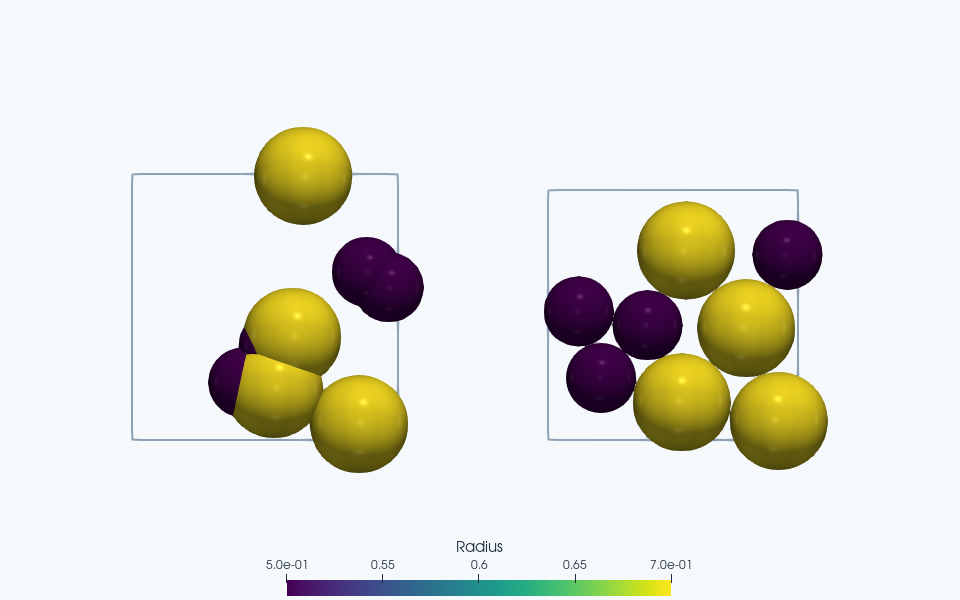
ParaView rendering of this run’s VTKWriter output.
Left to right: Before jamming; After jamming.
Single-system energy per sphere: 1.2034080508858315e-08
Single-system jamming fraction: 0.7330468750000001
Total running time of the script: (0 minutes 11.190 seconds)