Note
Go to the end to download the full example code.
Quasistatic shear of a small jammed disk packing#
An athermal quasistatic (AQS) step first applies an affine strain to particle centers and periodic images, then minimizes the energy at fixed strain. There is no physical loading rate or thermal noise in this protocol. The minimizer’s time step is a relaxation parameter, not a measured shear time.
We locate the jamming threshold of eight bidisperse disks and compress a little above it before shearing. This gives a small finite-overlap solid rather than a packing exactly at the vanishing-energy threshold. Its jamming fraction depends strongly on size and seed. Twelve strain steps illustrate the protocol; they are insufficient to infer a bulk yield stress.
Lengths, unit masses and unit spring stiffness use reduced units. Reported energy is per disk; contact virial stress is normalized by box area, with positive diagonal values for compression. Elastic branches and rearrangements can be studied by extending the run and checking strain-step and force-tolerance convergence. A rearrangement is not promised for this short deterministic run.
import jax
import jax.numpy as jnp

from dataclasses import replace

import numpy as np

import jaxdem as jdem
from jaxdem.utils.contacts import compute_contact_stress_tensor
from jaxdem.utils.packing_utils import scale_to_packing_fraction

jax.config.update("jax_enable_x64", True)
Affine loading followed by energy relaxation#
Write positions relative to the domain anchor (zero in this run). A strain increment changes the reference box and centers according to
The affine configuration starts the next minimization. The local minimum
reached depends on the preceding state; AQS follows a branch of equilibria
rather than finding the globally lowest energy at every strain. The library’s
domain.shear also updates the periodic geometry and any pair history.
For overlapping disks the spring energy is
Relaxation stops when force (and any active torque) residuals meet their
tolerances. A small energy alone does not establish equilibrium. Starting
above the finite-system threshold gives contacts a finite overlap before
loading; the energy printed by the minimizer is U/N.
With the compression-positive contact virial convention, a smooth relaxed branch of this conservative central-force system satisfies
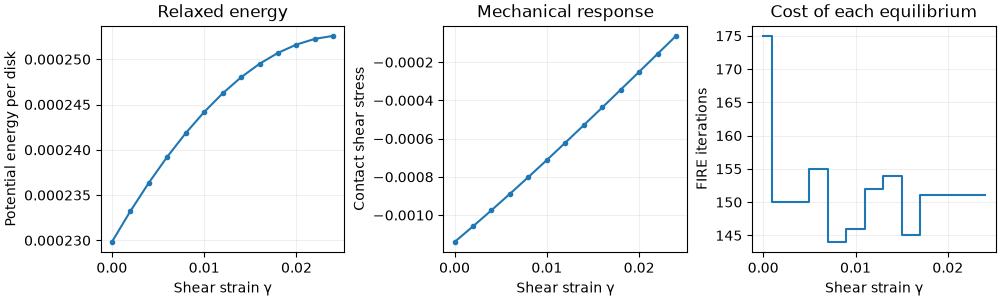
On such a branch the energy and stress vary smoothly. A loss of stability can trigger nonaffine rearrangement and an energy drop; its location depends on the strain increment and relaxation accuracy. That interpretation requires inspecting the configurations as well as the scalar output.
A bounded jamming search establishes a reproducible starting configuration.
N = 8
phi = 0.65
rad = jnp.concatenate([jnp.full(N // 2, 0.5), jnp.full(N // 2, 0.7)])
volume = jnp.pi * rad**2
L = jnp.sqrt(jnp.sum(volume) / phi)
state = jdem.State.create(
    pos=jax.random.uniform(jax.random.key(0), (N, 2), minval=0.0, maxval=L),
    rad=rad,
    mass=jnp.ones(N),
    volume=volume,
)
system = jdem.System.create(
    state=state,
    dt=0.01,
    rotation_integrator_type=None,
    minimizer=jdem.minimizers.fire,
    minimizer_kw={"dt": 0.05},
    domain_type="periodic",
    domain_kw={"box_size": jnp.full(2, L)},
    mat_table=jdem.MaterialTable.from_materials(
        [jdem.Material.create("elastic", young=1.0, poisson=0.3, density=1.0)]
    ),
)
jam = jdem.utils.jamming.bisection_jam(
    state,
    system,
    pe_tol=1e-8,
    pe_band_factor=4.0,
    packing_fraction_increment=0.04,
    packing_fraction_tolerance=1e-4,
    n_jamming_steps=80,
    verbose=False,
    minimizer_kwargs={"max_steps": 5_000, "force_tol": 1e-7, "torque_tol": 1e-7},
)
if not bool(jam.converged):
    raise RuntimeError(f"Jamming did not converge: {jam.info}")
state, system = jam.jammed_state, jam.jammed_system
solid_phi = float(jam.packing_fraction) + 0.02
state, system = scale_to_packing_fraction(state, system, solid_phi)
print(
    f"Finite-system phi_J = {float(jam.packing_fraction):.6f}; "
    f"solid phi = {solid_phi:.6f}"
)

system = replace(
    system,
    domain=jdem.Domain.create(
        "leesedwards",
        dim=2,
        box_size=system.domain.box_size,
        anchor=system.domain.anchor,
    ),
)
Finite-system phi_J = 0.733047; solid phi = 0.753047
Relax the compressed state before the first strain increment, then repeat affine shear followed by relaxation. Every accepted point satisfies the same force/torque criterion; reaching the iteration cap is a failure.
print("gamma   E/N        contact_sigma_xy  relaxation_steps")
measurements = []
scene_states, scene_systems = [], []
for step in range(13):
    if step:
        state, system = system.domain.shear(state, system, 0.002)
    result = system.minimize(
        state, system, max_steps=5_000, force_tol=1e-7, torque_tol=1e-7
    )
    if not bool(result.converged):
        raise RuntimeError(
            f"Relaxation failed at gamma={float(system.domain.gamma):.4f}"
        )
    state, system, steps, pe = result
    state, system, stress = compute_contact_stress_tensor(state, system)
    measurements.append(
        [float(system.domain.gamma), float(pe), float(stress[0, 1]), int(steps)]
    )
    scene_states.append(state)
    scene_systems.append(system)
    print(
        f"{float(system.domain.gamma):.4f}  {float(pe):.3e}  "
        f"{float(stress[0, 1]):.3e}  {int(steps)}"
    )
gamma   E/N        contact_sigma_xy  relaxation_steps
0.0000  2.298e-04  -1.141e-03  175
0.0020  2.332e-04  -1.059e-03  150
0.0040  2.364e-04  -9.747e-04  150
0.0060  2.392e-04  -8.887e-04  155
0.0080  2.418e-04  -8.010e-04  144
0.0100  2.442e-04  -7.118e-04  146
0.0120  2.462e-04  -6.213e-04  152
0.0140  2.480e-04  -5.297e-04  154
0.0160  2.495e-04  -4.371e-04  145
0.0180  2.507e-04  -3.439e-04  151
0.0200  2.516e-04  -2.503e-04  151
0.0220  2.523e-04  -1.562e-04  151
0.0240  2.526e-04  -6.215e-05  151
Read a quasistatic loading curve#
Each point is an accepted equilibrium. The horizontal axis is strain; relaxation iterations measure numerical work, not elapsed physical time. Smooth energy and stress branches do not guarantee a rearrangement within this short strain interval.
import matplotlib.pyplot as plt

measured = np.asarray(measurements)
fig, axes = plt.subplots(1, 3, figsize=(10, 3), layout="constrained")
axes[0].plot(measured[:, 0], measured[:, 1], "o-", ms=3)
axes[0].set(ylabel="Potential energy per disk", title="Relaxed energy")
axes[1].plot(measured[:, 0], measured[:, 2], "o-", ms=3)
axes[1].set(ylabel="Contact shear stress", title="Mechanical response")
axes[2].step(measured[:, 0], measured[:, 3], where="mid")
axes[2].set(ylabel="FIRE iterations", title="Cost of each equilibrium")
for axis in axes:
    axis.set_xlabel("Shear strain γ")
    axis.grid(alpha=0.2)
plt.show()
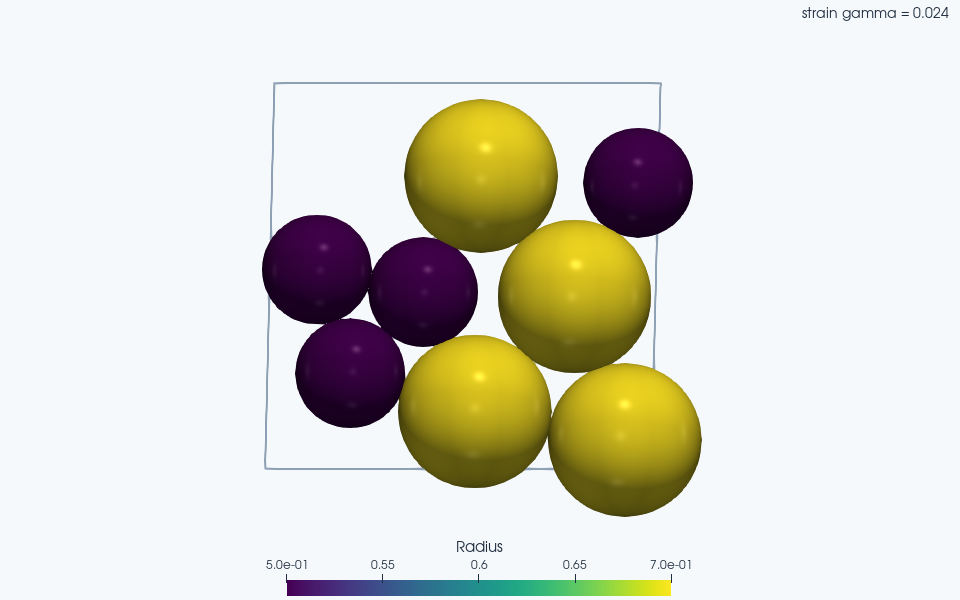
ParaView rendering of this run’s VTKWriter output.
Total running time of the script: (0 minutes 10.259 seconds)